Somewhere between energy shots at gas stations and wellness talk on podcasts, kratom quietly slipped into the mainstream. That is part of the problem.
What Is Kratom, and Why Are People Suddenly Worried About It?
As of October 22, 2025, kratom keeps surfacing in headlines, and not for feel good reasons. The concern is growing, fast. A lot of people have never heard of it, including many who work in mental health and healthcare, which makes the situation trickier than it should be. According to a recent APA survey, only 19 percent of U.S. adults even recognize the name. Meanwhile, the 2023 National Survey on Drug Use and Health estimates around 1.6 million Americans use it every year. That gap alone should raise eyebrows.
So this is a crash course. Not a scare piece, not a sales pitch. Just what kratom is, why doctors are uneasy, where the law stands, and what we actually know right now.
Let’s start with the basics
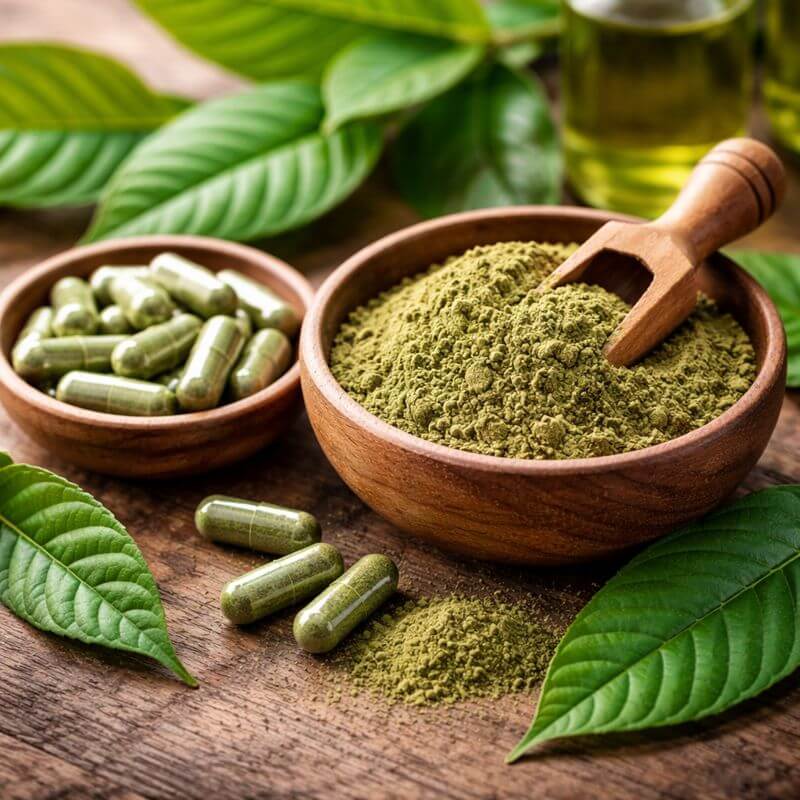
Kratom comes from a leafy tree native to Southeast Asia. For centuries, it was used locally in small doses, often brewed as tea. In the U.S., though, it took on a very different life. Today, kratom shows up as capsules, powders, tonics, pressed tablets, and sometimes things that barely resemble a plant at all. People are drawn to it for its psychoactive effects. Some say it helps with pain. Others say it boosts energy or eases anxiety. That is the sales pitch, anyway.
What changed, and what really set off alarm bells, is concentration. Highly concentrated kratom products, especially those rich in opioid like compounds naturally found in the plant, are now widely sold. That has put the medical community, the FDA, and the DEA on edge. Dependence and addiction are no longer theoretical risks. They are showing up in clinics and emergency rooms.
Understanding Opioids
Opioids are molecules that interact with opioid receptors in the body. We actually make our own. Endorphins, dynorphins, enkephalins, the stuff behind pain relief, pleasure, motivation, even digestion. Animals make them too. Some plants do as well. These molecules often act on the mu opioid receptor, which plays a major role in pain control and, unfortunately, addiction. Different opioids bind differently. Some barely whisper to the receptor. Others shout.
Kratom contains its own opioids
The main ones are mitragynine and 7-hydroxymitragynine, usually shortened to 7-OH. In natural kratom leaves, they exist in small amounts. In lab studies, rodents struggle to tell the difference between these compounds and morphine. That alone is telling. The real issue now is that modern kratom products often contain concentrated, high potency 7-OH. This is not your great grandfather’s leaf tea.
Serious medical complications have been linked to kratom and its derivatives, including overdose and death. Sometimes kratom is the only substance involved. Often it is part of a polysubstance mix, which makes the risk even harder to untangle. To be honest, we still do not fully understand how much danger comes from each compound on its own versus their role in combination overdoses. The data just is not there yet.
The Legal Mess
Despite years of data showing kratom’s opioid activity, it remains easy to buy. The FDA has consistently said kratom should not be used for human consumption, but enforcement has been spotty at best. In a surreal twist, some kratom manufacturers have even sponsored high profile college sports teams. That does not exactly scream caution.
Back in 2016, the DEA tried to classify kratom derivatives as Schedule 1 substances. The pushback was immediate and intense. Industry groups, constituents, and lawmakers applied pressure, and the proposal was pulled. Today, kratom is still unscheduled at the federal level.
More recently, the FDA proposed scheduling products that contain 7-OH above a certain concentration. The DEA has not acted on that request yet. The FDA has also not asked for kratom itself to be scheduled. At the state level, it is a patchwork. Some states ban it outright. Others restrict sales. Many have no rules at all. Internationally, several European and Asian countries have already made kratom illegal.
The Human Cost
Because it contains opioids, kratom can cause dependence and addiction. This is no longer hypothetical. Reports of kratom related fatal overdoses, including cases involving multiple substances and overdoses reversed with naloxone, are becoming more common. The numbers tell a grim story. In 2016, kratom was involved in about 0.5% of opioid related deaths. By 2022, that number had climbed to 2%.
People who use kratom regularly often develop dependence. When they stop, withdrawal symptoms can follow, much like other opioids. There is no official, universally accepted treatment guideline for kratom dependence yet. Clinicians usually treat it the same way they treat other opioid use disorders, combining medication with behavioral support. Small studies suggest medications like buprenorphine, methadone, and naltrexone can help. As the FDA has now clearly stated that 7-OH is an opioid, a formal declaration from HHS would go a long way toward improving diagnosis and access to care.
If someone overdoses on kratom, it should be treated as an opioid overdose. Naloxone should be given immediately, and 911 should be called. People who use kratom need clear education about the risks, including dependence and overdose. They should know how to use naloxone and carry it. Mixing kratom with other substances is a gamble that too often goes badly.
Mental health professionals have a role here too. Education matters. Screening matters. Recognizing dependence early and connecting patients with proper treatment or addiction specialists can make a real difference.
The Outlook is Uneasy
Kratom and its opioid derivatives are widely available, and the potential for harm is real. Long term health effects are still poorly understood. Optimal treatment strategies are still evolving. What is clear is this. Clinicians, both primary care and specialists, need to know what kratom is, ask about it, and include it in routine substance use screenings.
Ignoring it will not make it safer.